Ossila/26DCzPPy/1 g/M771

价格
¥3980.00
货号:M771
浏览量:127
品牌:Ossila
服务
全国联保
正品保证
正规发票
签订合同
商品描述

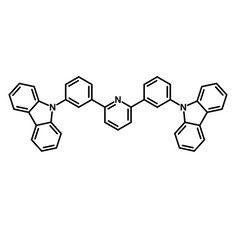
Combining carbazole electron donors with a high triplet energy and a pyridine electron acceptor with a high electron affinity, 2,6-bis(3-(carbazol-9-yl)phenyl)pyridine (26DCzPPy) is one of the most popular bipolar host materials used in organic light-emitting diodes.

Bipolar host materials are molecules composed of an electron-donating moiety capable of mediating hole injection and transportation, and an electron-withdrawing moiety capable of mediating electron injection and transportation.

General Information

CAS number1013405-24-7
Chemical formulaC41H27N3
Molecular weight561.67 g/mol
Absorptionλmax 239, 292 nm (in CH2Cl2)
Fluorescenceλem 410 nm (in CH2Cl2)
HOMO/LUMOHOMO = 6.05 eV, LUMO = 2.56 eV [1]
Synonyms
  • 2,6-bis[3-(9H-Carbazol-9-yl)phenyl]pyridine
  • DCzPPy
Classification / FamilyCarbazole derivatives, Bipolar charge transport layer materials, Phosphorescent host materials, OLEDs, Organic electronics

Product Details

Purity>98.0%
Melting pointTGA > 370 °C (0.5% weight loss)
AppearanceWhite powder/crystals

Chemical Structure

Chemical structure of 26DCzPPY
Chemical structure of 2,6-bis[3-(9H-Carbazol-9-yl)phenyl]pyridine (26DCzPPy)

Device Structure(s)

Device structure ITO/TAPC (40 nm)/TCTA (2 nm)/26DCzPPy:TCTA:FIrpic (0.4:0.4:0.2) (5 nm)/26DCzPPy:PPT:FIrpic (0.4:0.4:0.2) (5 nm)/3TPYMB (55 nm)/CsF (2 nm)/Al (180 nm) [1]
ColourBlue   blue
Power Efficiency @ 1000 cd/m224 lm W−1
Current Efficiency @ 1000 cd/m242 cd/A
Power Efficiency @ 1000 cd/m230 lm/W
Device structureITO/TAPC (40 nm)/TCTA (2 nm)/26DCzPPy:TCTA :FIrpic/26DCzPPy:TCTA:FIrpic:Os/26DCzPPy:PPT:FIrpic:Os/26DCzPPy: PPT:FIrpic/3TPYMB (55 nm)/CsF (2 nm)/Al (180 nm) [1]    
ColourWhite   white
Current Efficiency @ 1000 cd/m235.7 cd/A
Device structure ITO/PEDOT: PSS (60 nm)/26DCzPPy:FIrpic (10 wt.%, 60 nm)/TmPyPB (30 nm)/LiF (1 nm)/Al (100 nm) [2]
ColourBlue   blue
Max. EQE12.1%
Max Current Efficiency21.8 cd/A
Max Power Efficiency12.7 lm/W
Device structureITO/PEDOT: PSS (60 nm)/TCTA:26DCzPPy:FIrpic (10 wt.%, 60 nm)/TmPyPB (30 nm)/LiF (1 nm)/Al (100 nm) [2]
ColourBlue   blue
Max. EQE14.6%
Max Current Efficiency25.1 cd/A
Max Power Efficiency15.7 lm/W
Device structureITO/TAPC:MoOx (10 nm, 15 wt.%)/TAPC(35 nm)/TcTa:Ir(BT)2(acac) (5 nm, 4 wt.%)/26DCzPPy:FIrpic (5 nm, 15 wt.%)/26DCzPPy:Ir(BT)2(acac) (5 nm, 4 wt.%)/BPhen (40 nm)/Cs2CO3(1 nm)/Al (100 nm) [3]
ColourWhite   white
Max. EQE13.2%
Max. Current Efficiency35.0 cd/A
Max. Power Efficiency30.6 lm W1
Device structureSi/SiO2/Al (80 nm)/MoOx: TAPC (43 nm, 15 wt.%)/TAPC (10 nm)/Ir(piq)3:TcTa (3 nm, 6%)/TcTa (2 nm)/FIrpic:26DCzPPy (5 nm, 12 wt.%)/BPhen (2 nm)/PO-01*:26DCzPPy (5 nm, 6 wt.%)/BPhen (40 nm)/Cs2CO3 (1 nm)/Al (2 nm)/Cu (18 nm)/TcTa (60 nm) [4]
ColourWhite   white
EQE @ 1000 cd/m210%
Current Efficiency @ 1000 cd/m225.6 cd/A
Power Efficiency @ 1000 cd/m220.1 lm W1
Device structurePEN (120 mm)/ITO (170 nm)/MeO-TPD:F4-TCNQ (100 nm, 4%)/NPB (15 nm)/TCTA (5 nm)/TCTA:Ir(dmppy)2(dpp) (1 nm, 20%)/TCTA:FIrpic (4 nm, 7%)/26DCzPPy:FIrpic (4 nm, 20%)/26DCzPPy:Ir(dmppy)2(dpp) (1 nm, 20%)/TmPyPB (50 nm)/LiF (1 nm)/Al (200 nm) [5]                
ColourWhite   white
Max. Current Efficiency96.8 cd/A
Max. Power Efficiency101.3 lm W−1
Device structureITO (90 nm)/HATCN (5 nm)/TAPC (65 nm)/10 wt% fac -Ir(mpim)3 –doped TCTA (5 nm)/10 wt% fac -Ir(mpim)3 -doped 26DCzPPy (5 nm)/B3PyPB* (65 nm)/Liq (2 nm)/Al (80 nm) [6]
ColourBlue blue
EQE @ 100 cd/m229.6%
Current Efficiency @ 100 cd/m273.2 cd/A
Power Efficiency @ 100 cd/m275.6 lm/W
Device structureITO/PEDOT:PSS (50 nm)/TCTA (30 nm)/26DCzPPy:Ir(mppy)3 94:6 (40 nm)/TPBI (40 nm)/LiF (0.8 nm)/Al (100 nm)  [7]
ColourGreen    green
Current Efficiency @ 1000 cd/m241.9 cd/A
Power Efficiency @ 1000 cd/m223.4 lm W1  
Device structureITO/TAPC (40 nm)/TcTa (10 nm)/5a* (4%):TcTa (5 nm)/5a* (4%):26DCzPPy (10 nm)/TmPyPB (40 nm)/LiF(1 nm)/Al(100 nm) [8]
ColourRed    red
Max. Luminance11,023 cd/m2
Max. Current Efficiency17.36 cd/A
Max. Power Efficiency14.73 lm W1  

*For chemical structure information please refer to the cited references.

MSDS Documentation

26DCzPPy MSDS26DCzPPy MSDS sheet

Literature and Reviews

  1. Blue and white phosphorescent organic light emittingdiode performance improvementbyconfining electrons and holes inside double emitting layers, Y-S.Tsai et al., J. Luminescence 153, 312–316 (2014); http://dx.doi.org/10.1016/j.jlumin.2014.03.040.
  2. Soluble processed low-voltage and high efficiency blue phosphorescent organic light-emitting devices using small molecule host systems, Y. Doh et al., Org. Electronics, 13, 586–592 (2012); doi:10.1016/j.orgel.2012.01.003.
  3. Color stable and low driving voltage white organic light-emitting diodes with low efficiency roll-off achieved by selective hole transport buffer layers, Z. Zhang et al., Org. Electronics 13, 2296–2300 (2012); http://dx.doi.org/10.1016/j.orgel.2012.07.001.
  4. High performance top-emitting and transparent white organic light-emitting diodes based on Al/Cu/TcTa transparent electrodes for active matrix displays and lighting applications, Z. Zhang et al., Org. Electronics,14, 1452–1457 (2013); http://dx.doi.org/10.1016/j.orgel.2013.03.007.
  5. Extremely stable-color flexible white organic lightemitting diodes with efficiency exceeding 100 lmW-1, B. Liu et al., J. Mater. Chem. C, 2, 9836 (2014); DOI: 10.1039/c4tc01582g.
  6. Low-Driving-Voltage Blue Phosphorescent Organic Light-Emitting Devices with External Quantum Efficiency of 30%, K. Udagawa et al., Adv. Mater., 26, 5062–5066 (2014); DOI: 10.1002/adma.201401621.
  7. Interface and thickness tuning for blade coated small-molecule organic light-emitting diodes with high power efficiency, Y-F. Chang et al., Appl. Phys. Lett.,114, 123101 (2013); doi: 10.1063/1.4821881.
  8. Efficient red organic electroluminescent devices by doping platinum(II) Schiff base emitter into two host materials with stepwise energy levels, L. Zhou et al., Opt. Lett., 38 (14), 2373-2375 (2013);http://dx.doi.org/10.1364/OL.38.002373.

To the best of our knowledge the technical information provided here is accurate. However, Ossila assume no liability for the accuracy of this information. The values provided here are typical at the time of manufacture and may vary over time and from batch to batch.


专家支持 我们在这里为您提供帮助。我们的使命是为我们的产品提供最佳的技术支持,因此,如果您有任何疑问,请随时与我们联系。请更一般地享受这些指南,评论和对我们系统以及相关理论的概述。 视频指南和教程 使用PDMS进行2D材料的粘弹性转移 制作OLED和OPV太阳能电池:快速入门指南 空气钙钛矿设备 所有影片 书面指南和应用说明 旋涂 旋涂:膜厚指南 旋涂:难处理溶液指南 解决方案处理技术:比较 接触角:理论和测量指南 表面能指南 表面润湿的接触角测量 在不平坦表面上的接触角测量 薄层电阻:理论指南 四点探针测量指南 薄膜的薄层电阻测量 浸涂理论:膜厚 浸涂:缺陷故障排除指南 缝模涂布:理论,设计与应用 槽模涂布:缺陷故障排除指南 太阳能电池:理论与测量指南 IV曲线:测量指南 有机光伏:简介 有机光伏与第二代太阳能电池技术 有机光伏与第三代太阳能电池技术 OPV和OLED制作指南 大规模沉积有机太阳能电池 有机光伏绿色溶剂 钙钛矿和钙钛矿太阳能电池-简介 钙钛矿加工 FTO基板:将非图案化基板用于光伏设备 钙钛矿太阳能电池:增加稳定性和耐用性的方法 钙钛矿太阳能电池:退化的原因 钙钛矿太阳能电池:钝化技术 钙钛矿常见问题 二维材料简介 使用PDMS进行2D材料的粘弹性转移 二硫化钼 使用环保材料将氧化石墨烯还原为石墨烯 基于解决方案的OFET 什么是OLED? OLED测试指南 循环伏安法:电化学技术简介     文献评论:博士生凝聚 一名博士生凝结:OPV处理条件的影响 一名博士生凝视:ITIC及其衍生物成为OPV受体 一名博士生凝结:微调的ADA小分子受体 一名博士生凝结:影响OPV稳定性的因素 一名博士生凝结:三元有机太阳能电池简介 博士生凝聚:为新研究人员编写代码     系统概述 光伏基板概述 OLED基板(像素阳极)系统概述 低密度OFET制造系统概述和原理图 高密度OFET制造系统概述和原理图 解决方案处理的OFET基板系统概述 长通道OFET制作系统概述 Luminosyn™高纯聚合物