Rubrene, a molecule with a tetracene backbone and four appended phenyl rings, is one of the most studied molecular semiconductors due to its high charge mobility. Notably, room-temperature hole mobilities of the order of 20-40 cm2V-1s-1 have been measured for rubrene in single-crystal organic field-effect transistors (SC-OFET) [1]. It is widely used in organic electronics, especially organic light-emitting diodes (OLEDs) and organic field-effect transistors (OFETs).
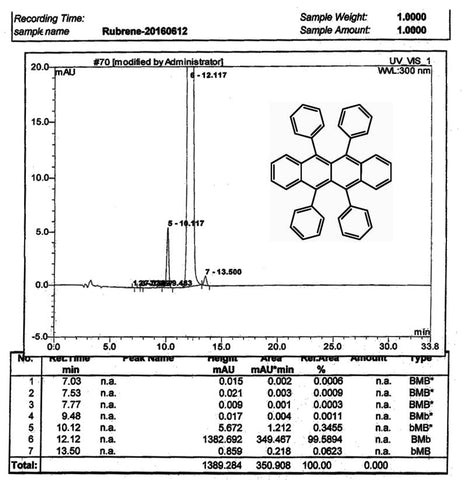
HPLC trace of 5,6,11,12-tetraphenylnaphthacene (rubrene)
MSDS Documentation
Rubrene MSDS sheet
Literature and Reviews
Organic field-effect transistors using single crystals, T. Hasegawa et al., Sci. Technol. Adv. Mater. 10, 024314 (2009), doi:10.1088/1468-6996/10/2/024314.
Rubrene: The Interplay between Intramolecular and Intermolecular Interactions Determines the Planarization of Its Tetracene Core in the Solid State, C. Sutton et al., J. Am. Chem. Soc., 137, 8775-8782 (2015)
Luminescence of Rubrene and DCJTB molecules in organic light-emitting devices, C-B. Moon et al., J. Luminescence, 146, 314-320, 2014.
The effect of rubrene as a dopant on the efficiency and stability of organic thin film electroluminescent devices, Z. Zhang et al., J. Phys. D: Appl. Phys. 31, 32–35 (1998).
Performance improvement of rubrene-based organic light emitting devices with a mixed single layer, Z. Wang et al., Appl Phys A 100: 1103–1108 (2010), DOI 10.1007/s00339-010-5710-4.
Efficient and stable single-dopant white OLEDs based on 9,10-bis (2-naphthyl) anthracene, S. Tao et al., J. Luminance, 121(2), 568-572 (2006); doi:10.1016/j.jlumin.2005.12.053.
Organic white light electroluminescent devices, S. Liu et al., Thin Solid Films, 363, 294-297 (2000); doi:10.1016/S0040-6090(99)01017-2.
Influence of Dopant Concentration on Electroluminescent Performance of Organic White-Light-Emitting Device with Double-Emissive-Layered Structure, M. Wu et al., Chin. Phys. Lett., 25, 294-297 (2008).
Co-Host Comprising Hole-Transporting and Blue-Emitting Components for Efficient Fluorescent White OLEDs, Y-C. Chen et al., J. Electrochem. Soc., 159 (4) J127-J131 (2012); doi: 10.1149/2.092204jes.
White organic light-emitting devices using Zn(BTZ)2 doped with Rubrene as emitting layer,J. Zheng et al., Chin. Sci. Bull., 50, 509-513 (2005); DOI: 10.1360/04wb0050.
To the best of our knowledge the technical information provided here is accurate. However, Ossila assume no liability for the accuracy of this information. The values provided here are typical at the time of manufacture and may vary over time and from batch to batch.




 Rubrene MSDS sheet