


- pce11 (pffbt4t2od) from £296.00
- 3m9002假的有用吗
- Ossila狭缝挤出式旋涂机性能参数,报价/价格,图片
- 欧西拉/Ossila非真空旋涂仪精巧型功能应用性能参数,报价/价格,图片...
- OS匀胶旋涂仪迈可诺技术有限公司
- ossila ossila批发价格、市场报价、厂家供应
- 磷酸钾(Potassium phosphate)「CAS号:7778532」 – 960 ...
- Ossila/DMACDPS | 1477512325/250 mg/M2121A1_杯_耗材_其它...
- Ossila狭缝涂布仪_华仪行(北京)科技有限公司
- 杰出青年科学家奖
- “超级人类”:霍金担心基因改造会让自然人类灭绝
- Ossila__迈可诺技术有限公司


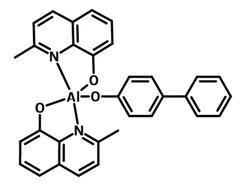
Bis(8-hydroxy-2-methylquinoline)-(4-phenylphenoxy)aluminum, known as BAlq or BAlq3, is widely used as blue-emitting layer materials in organic light-emitting diodes. It is also used as hole-blocking layer or as a “barrier-softening” interfacial layer in between the electron transporting and emissive layers [1, 2, 3, 4].
BAlq is also applied as the host material and electron-transport type hole-blocking layer in red PHOLEDs, and to improve the efficiency and lifetime of PHOLEDs. As a hole-blocking material, it is known to allow for high lifetimes, up to 160,000 hours at a luminance level of 100 cd/m2 [3].
BAlq has a glass transition temperature of 99 °C and is photochemically stable [5].
General Information
| CAS number | 146162-54-1 |
| Chemical formula | C32H25AlN2O3 |
| Molecular weight | 512.53 g/mol |
| Absorption | λmax 259 nm (in THF) |
| Fluorescence | λem 334,477 nm (in THF) |
| HOMO/LUMO | HOMO = 5.9 eV, LUMO = 2.9 eV |
| Synonyms |
|
| Classification / Family | Electron transporting materials, Hole blocking materials, Light emitter layer materials, Phosphorescent host materials, Organic light-emitting diodes, Organic electronics, Sublimed materials |
Product Details
Purity | >99% (sublimed) |
| Melting point | Melting point/range: 207 - 214 °C (lit.) |
| Colour | Light-yellow powder/crystals |
*Sublimation is a technique used to obtain ultra pure-grade chemicals. For more details about sublimation, please refer to the Sublimed Materials for OLED devices page.
Chemical Structure
Device Structure(s)
| Device structure | ITO (110 nm)/NPB(80 nm)/BtpIr*-doped BAlq (47.5 nm)/Alq3(30 nm)/Li2O(0.5nm)/Al(100nm) [5] |
| Colour | Red  |
| Max. EQE | 8.6% |
| Max. Luminance | 179 cd/m2 |
| Device structure | ITO/CuPc (15 nm)/NPB (80 nm)/NPB: 0.5 wt% DCJTB (20 nm) /Alq3:0.5 wt% C545T (3 nm)/MADN:0.8 wt% DSA-ph*(40 nm)/BAlq3 (10 nm)/LiF/Al [6] |
| Colour | White  |
| Max. Luminance | 45,000 cd/m2 |
| Max. Current Efficiency | 20.8 cd/A |
| Max. Power Efficiency | 15.9 lm W−1 |
| Device structure | ITO/MoOx (5 nm)/NPB (40 nm)/4% Y-Pt*:TCTA (20 nm)/8% FIrpic:mCP(10 nm)/8% FIrpic:UGH2 (10 nm)/BAlq (40 nm)/LiF (0.5 nm)/Al (100 nm) [7] |
| Colour | White |
| Max. EQE | 16.0% |
| Max. Current Efficiency | 45.6 cd/A |
| Max. Power Efficiency | 35.8 lm W−1 |
*For chemical structure informations please refer to the cited references
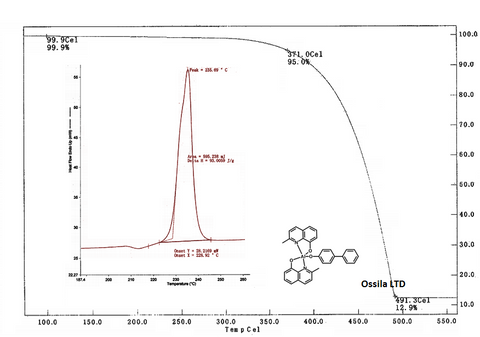
Characterisation (TGA and DSC)
MSDS Documentation
 BAlq MSDS sheet
Literature and Reviews
- Electroluminescent properties of organic light-emitting diodes using BAlq and Alq3 co-evaporation layer, Y. Iwama et al., Thin Solid Films 499, 364-368 (2006).
- Electroluminescent mechanism of organic light-emitting diodes with blue-emitting Alq, T. Itoh et al., Colloids and Surfaces A: Physicochem. Eng. Aspects 284–285, 594–598 (2006).
- A host material containing tetraphenylsilane for phosphorescent OLEDs with high efficiency and operational stability, J-W. Kang et al., Org. Electronic, 9, 452–460 (2008).
- Electron transport in the organic small-molecule material BAlq — the role of correlated disorder and traps, S.L.M. van Mensfoort et al., Org. Electronic, 11, 1408–1413 (2010).
- Distinguished Paper: Red-Phosphorescent OLEDs Employing Bis(8-Quinolinolato)-Phenolato-Aluminum(III) Complexes as Emission-Layer Hosts, T. Tsuji et al., SID Symposium Digest of Technical Papers, 35 (1), 900-903 (2012).
- High efficiency fluorescent white organic light-emitting diodes with red, green and blue separately monochromatic emission layers, Z. Zhang et al., Org. Electronics, 10, 491-495 (2009); doi:10.1016/j.orgel.2009.02.006.
- High Efficiency White Organic Light-Emitting Devices Incorporating Yellow Phosphorescent Platinum(II) Complex and Composite Blue Host, S-L. Lai et al., Adv. Funct. Mater., 23, 5168–5176 (2013); DOI: 10.1002/adfm.201300281.
To the best of our knowledge the technical information provided here is accurate. However, Ossila assume no liability for the accuracy of this information. The values provided here are typical at the time of manufacture and may vary over time and from batch to batch.
专家支持 我们在这里为您提供帮助。我们的使命是为我们的产品提供最佳的技术支持,因此,如果您有任何疑问,请随时与我们联系。请更一般地享受这些指南,评论和对我们系统以及相关理论的概述。 视频指南和教程 使用PDMS进行2D材料的粘弹性转移 制作OLED和OPV太阳能电池:快速入门指南 空气钙钛矿设备 所有影片 书面指南和应用说明 旋涂 旋涂:膜厚指南 旋涂:难处理溶液指南 解决方案处理技术:比较 接触角:理论和测量指南 表面能指南 表面润湿的接触角测量 在不平坦表面上的接触角测量 薄层电阻:理论指南 四点探针测量指南 薄膜的薄层电阻测量 浸涂理论:膜厚 浸涂:缺陷故障排除指南 缝模涂布:理论,设计与应用 槽模涂布:缺陷故障排除指南 太阳能电池:理论与测量指南 IV曲线:测量指南 有机光伏:简介 有机光伏与第二代太阳能电池技术 有机光伏与第三代太阳能电池技术 OPV和OLED制作指南 大规模沉积有机太阳能电池 有机光伏绿色溶剂 钙钛矿和钙钛矿太阳能电池-简介 钙钛矿加工 FTO基板:将非图案化基板用于光伏设备 钙钛矿太阳能电池:增加稳定性和耐用性的方法 钙钛矿太阳能电池:退化的原因 钙钛矿太阳能电池:钝化技术 钙钛矿常见问题 二维材料简介 使用PDMS进行2D材料的粘弹性转移 二硫化钼 使用环保材料将氧化石墨烯还原为石墨烯 基于解决方案的OFET 什么是OLED? OLED测试指南 循环伏安法:电化学技术简介 文献评论:博士生凝聚 一名博士生凝结:OPV处理条件的影响 一名博士生凝视:ITIC及其衍生物成为OPV受体 一名博士生凝结:微调的ADA小分子受体 一名博士生凝结:影响OPV稳定性的因素 一名博士生凝结:三元有机太阳能电池简介 博士生凝聚:为新研究人员编写代码 系统概述 光伏基板概述 OLED基板(像素阳极)系统概述 低密度OFET制造系统概述和原理图 高密度OFET制造系统概述和原理图 解决方案处理的OFET基板系统概述 长通道OFET制作系统概述 Luminosyn™高纯聚合物