


- “超级人类”:霍金担心基因改造会让自然人类灭绝
- 3m9002假的有用吗
- 磷酸钾(Potassium phosphate)「CAS号:7778532」 – 960 ...
- Ossila__迈可诺技术有限公司
- OS匀胶旋涂仪迈可诺技术有限公司
- Ossila狭缝涂布仪_华仪行(北京)科技有限公司
- Ossila狭缝挤出式旋涂机性能参数,报价/价格,图片
- 欧西拉/Ossila非真空旋涂仪精巧型功能应用性能参数,报价/价格,图片...
- Ossila/DMACDPS | 1477512325/250 mg/M2121A1_杯_耗材_其它...
- 杰出青年科学家奖
- ossila ossila批发价格、市场报价、厂家供应
- pce11 (pffbt4t2od) from £296.00


DPP-DTT is a high mobility p-type polymer, suitable for OFET and sensing and photovoltaic applications.
Luminosyn™ DPP-DTT
Luminosyn™ DPP-DTT (also referred to as PDPP2T-TT-OD) is now available.
High molecular weightHigher molecular weight offers higher charge mobility
High purityDPP-DTT is purified via Soxhlet extraction with methanol, hexane and chlorobenzene under an argon atmosphere
Batch-specific GPC dataHave confidence in what you are ordering; batch-specific GPC data for your thesis or publications
Large quantity ordersPlan your experiments with confidence with polymers from the same batch
OFET and Sensing Applications
The exceptional high mobility of this polymer of up to 10 cm2/Vs [2] via solution-processed techniques, combined with its intrinsic air stability (even during annealing) has made PDPP2T-TT-OD of significant interest for OFET and sensing purposes.
While the highest mobilities require exceptional molecular weights of around 500 kD (and with commensurate solubility issues), high mobilities in the region of 1-3 cm2/Vs can still be achieved with good solution-processing at around 250 kD. As such, we have made a range of molecular weights available to allow for different processing techniques.
In our own tests, we have found that by using simple spin-coating onto an OTS-treated silicon substrate (using our prefabricated test chips), high mobilities comparable to the literature can be achieved (1-3 cm2/Vs). Further improvements may also be possible with more advanced strain-inducing deposition techniques.


Photovoltaic Applications
Although shown as a promising hole-mobility polymer for OFETs, when used as the donor material in a bulk heterojunction photovoltaic (with PC70BM as the acceptor), initial efficiencies of 1.6% were achieved for DPP-DTT [3]. The low device metrics were attributed to poor film morphology. However, a higher efficiency of 6.9% was achieved by using thicker film (220 nm) [4].
PDPP2T-TT-OD has also recently been used successfully as an active-layer dopant material in PTB7-based devices [5]. An improvement in device performance was observed, with average efficiencies increasing from 7.6% to 8.3% when the dopant concentration of DPP-DTT was 1 wt%. The use of DPP-DTT as a high-mobility hole-interface layer for perovskite hybrid devices has also been investigated [6].
Synthetic route
DPP-DTT synthesis: DPP-DTT was synthesised by following the procedures described in [2] and [3] (please refer to the following references):
With 2-thiophenecarbonitrile and dimethyl succinate as starting materials in t-amyl alcohol, it gave 3,6-Dithiophen-2-yl-2,5-dihydropyrrolo[3,4-c]pyrrole-1,4-dione. Alkylation of 3,6-Dithiophen-2-yl-2,5-dihydropyrrolo[3,4-c]pyrrole-1,4-dione with 2-octyldodecylbromide in dimethylformamide afforded 3,6-bis(thiophen-2-yl)-2,5-bis(2-octyldodecyl)pyrrolo[3,4-c]pyrrole-1,4(2H,5H)-dione. Further bromination gave 3,6-bis(5-bromothiophen-2-yl)-2,5-bis(2-octyldodecyl)pyrrolo[3,4-c]pyrrole-1,4(2H,5H)-dione (M1).
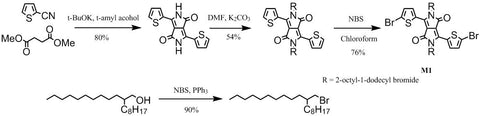
Further reaction of M1 with 2,5-bis(trimethylstannyl)thieno[3,2-b]thiophene (M2) under Stille coupling conditions gave the target polymer DPP-DTT, which was further purified via Soxhlet extraction with methanol, hexane and then chloroform.

General Information
| CAS number | 1260685-66-2 (1444870-74-9) |
| Chemical formula | (C60H88N2O2S4)n |
| HOMO / LUMO | HOMO = -5.2 eV, LUMO = -3.5 eV [2] |
| Synonyms |
|
| Solubility | Chloroform, chlorobenzene and dichlorobenzene |
| Classification / Family | Bithiophene, Thienothiophene, Organic semiconducting materials, Low band-gap polymers, Organic photovoltaics, Polymer solar cells, OFETs |

MSDS Documentation
 DPP-DTT MSDS sheet
Pricing
| Batch | Quantity | Price |
| M0311A1 | 100 mg | £199.00 |
| M0311A1 | 250 mg | £399.00 |
| M0311A1 | 500 mg | £686.00 |
| M0311A1 | 1 g | £1200.00 |
| M0311A1 | 2 g | £2200.00 |
| M0311A1 | 5 g / 10 g* | Please enquire |
*For 5 - 10 grams order quantity, the lead time is 4-6 weeks.
Batch information
| Batch | Mw | Mn | PDI | Stock info |
| M314 | 292,200 | 74,900 | 3.90 | Discontinued |
| M315 | 278,781 | 76,323 | 3.65 | Discontinued |
| M316 | ≥30,000 | ≤3 | Discontinued | |
| M317 | 290,668 | 143,039 | 2.03 | Discontinued |
| M0311A1 | 183,332 | 37,335 | 4.91 | In stock |
References
- A High Mobility P-Type DPP-Thieno[3,2-b]thiophene Copolymer for Organic Thin-Film Transistors, Y. Li et al., Adv. Mater., 22, 4862-4866 (2010)
- A stable solution-processed polymer semiconductor with record high-mobility for printed transistors, J. Li et al., Nature Scientific Reports, 2, 754, DOI: 10.1038/srep00754 (2012)
- Synthesis of low bandgap polymer based on 3,6-dithien-2-yl-2,5-dialkylpyrrolo[3,4-c]pyrrole-1,4-dione for photovoltaic applications, G. Zhang et al., Sol. Energ. Mat. Sol. C., 95, 1168-1173 (2011)
- Efficient small bandgap polymer solar cells with high fill factors for 300 nm thick films, Li W et al., Adv Mater., 25(23):3182-3186 (2013); doi:10.1002/adma.201300017.
- Enhanced efficiency of polymer solar cells by adding a high-mobility conjugated polymer, S. Liu et al., Energy Environ. Sci., 8, 1463-1470 (2015)
- Electro-optics of perovskite solar cells, Q. Lin et al., Nature Photonics, 9, 106-112 (2015)
- A Vertical Organic Transistor Architecture for Fast Nonvolatile Memory, X. She et al., adv. Mater., 29, 1604769 (2017); DOI: 10.1002/adma.201604769.
- Solvent-Free Processable and Photo-Patternable Hybrid Gate Dielectric for Flexible Top-Gate Organic Field-Effect Transistors, J. S. Kwon et al., ACS Appl. Mater. Interfaces, 9 (6), 5366–5374 (2017); DOI: 10.1021/acsami.6b14500.
To the best of our knowledge the technical information provided here is accurate. However, Ossila assume no liability for the accuracy of this information. The values provided here are typical at the time of manufacture and may vary over time and from batch to batch.
专家支持 我们在这里为您提供帮助。我们的使命是为我们的产品提供最佳的技术支持,因此,如果您有任何疑问,请随时与我们联系。请更一般地享受这些指南,评论和对我们系统以及相关理论的概述。 视频指南和教程 使用PDMS进行2D材料的粘弹性转移 制作OLED和OPV太阳能电池:快速入门指南 空气钙钛矿设备 所有影片 书面指南和应用说明 旋涂 旋涂:膜厚指南 旋涂:难处理溶液指南 解决方案处理技术:比较 接触角:理论和测量指南 表面能指南 表面润湿的接触角测量 在不平坦表面上的接触角测量 薄层电阻:理论指南 四点探针测量指南 薄膜的薄层电阻测量 浸涂理论:膜厚 浸涂:缺陷故障排除指南 缝模涂布:理论,设计与应用 槽模涂布:缺陷故障排除指南 太阳能电池:理论与测量指南 IV曲线:测量指南 有机光伏:简介 有机光伏与第二代太阳能电池技术 有机光伏与第三代太阳能电池技术 OPV和OLED制作指南 大规模沉积有机太阳能电池 有机光伏绿色溶剂 钙钛矿和钙钛矿太阳能电池-简介 钙钛矿加工 FTO基板:将非图案化基板用于光伏设备 钙钛矿太阳能电池:增加稳定性和耐用性的方法 钙钛矿太阳能电池:退化的原因 钙钛矿太阳能电池:钝化技术 钙钛矿常见问题 二维材料简介 使用PDMS进行2D材料的粘弹性转移 二硫化钼 使用环保材料将氧化石墨烯还原为石墨烯 基于解决方案的OFET 什么是OLED? OLED测试指南 循环伏安法:电化学技术简介 文献评论:博士生凝聚 一名博士生凝结:OPV处理条件的影响 一名博士生凝视:ITIC及其衍生物成为OPV受体 一名博士生凝结:微调的ADA小分子受体 一名博士生凝结:影响OPV稳定性的因素 一名博士生凝结:三元有机太阳能电池简介 博士生凝聚:为新研究人员编写代码 系统概述 光伏基板概述 OLED基板(像素阳极)系统概述 低密度OFET制造系统概述和原理图 高密度OFET制造系统概述和原理图 解决方案处理的OFET基板系统概述 长通道OFET制作系统概述 Luminosyn™高纯聚合物