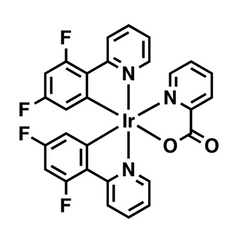
Bis[2-(4,6-difluorophenyl)pyridinato-C2,N](picolinato)iridium, abbreviated as FIrPic, F2IrPic or Ir(difppy)2(pic), is one of the most investigated bis-cyclometallated iridium complexes in particular in the context of organic light emitting diodes (OLEDs). This is because of its attractive sky-blue emission, high emission efficiency, and suitable energy levels as a phosphorescent dopant material.
Iridium complex, Phosphorescent blue emitter, Organic light-emitting diodes, Organic electronics
Product Details
Purity
>99.5% (Sublimed)
>98.0% (Unsublimed)
Melting point
330-335 °C (lit.)
Appearance
Yellow powder
*Sublimation is a technique used to obtain ultra pure-grade chemicals. For more details about sublimation, please refer to the Sublimed Materials for OLED devices page.
Chemical Structure
Chemical structure of Bis[2-(4,6-difluorophenyl)pyridinato- C2,N](picolinato)iridium(III)
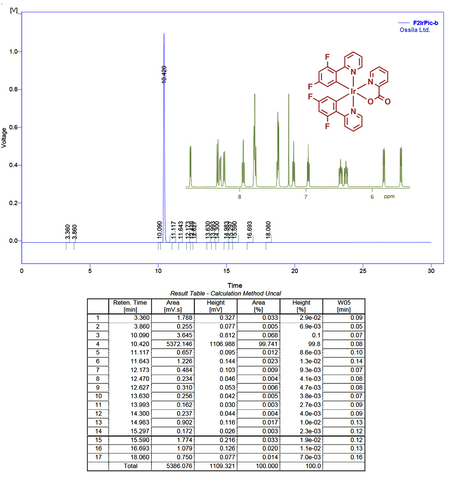
HPLC trace of Bis[2-(4,6-difluorophenyl)pyridinato-C2,N](picolinato)iridium(III) (FIrPic, F2IrPic)
Pricing
Grade
Order Code
Quantity
Price
Sublimed (>99.5% purity)
M711
250 mg
£329.00
Sublimed (>99.5% purity)
M711
500 mg
£582.00
Unsublimed (>98.0% purity)*
M712
250 mg
£205.00
*low stock
MSDS Documentation
FIrpic MSDS sheet
Literature and Reviews
Band Alignment at Anode/Organic Interfaces for Highly Efficient Simplified Blue-Emitting Organic Light-Emitting Diodes, Z. Liu et al.,., J. Phys. Chem. C, 114, 16746–16749 (2010).
White organic light-emitting devices employing phosphorescent iridium complex as RGB dopants, R. Song et al., Semicond. Sci. Technol. 22, 728–731 (2007); doi:10.1088/0268-1242/22/7/009.
High Power Efficiency Solution-Processed Blue Phosphorescent Organic Light-Emitting Diodes Using Exciplex-Type Host with a Turn on Voltage Approaching the Theoretical Limit, X. Ban et al., ACS Appl. Mater. Interfaces, 7, 25129−25138 (2015); DOI: 10.1021/acsami.5b06424.
Dependence of Light-Emitting Characteristics of Blue Phosphorescent Organic Light-Emitting Diodes on Electron Injection and Transport Materials, Jeong-Ik Lee et al. ETRI J., 34 (5), 690-695 (2012).
Highly efficient single-emitting-layer white organic light-emitting diodes with reduced efficiency roll-off, Q Wang, et al., Appl. Phys. Lett.,94, 103503 (2009); doi: 10.1063/1.3097028.
High efficiency blue phosphorescent organic light-emitting diode based on blend of hole- and electron-transporting materials as a co-host, Y. Chen et al., Appl. Phys. Lett. 100, 213301 (2012); doi: 10.1063/1.4720512.
Study of Sequential Dexter Energy Transfer in High Efficient Phosphorescent White Organic Light-Emitting Diodes with Single Emissive Layer, J-K. Kim et al., Sci. Reports, 4, 7009 (2014); DOI: 10.1038/srep07009.
Improved color stability in white phosphorescent organic light-emitting diodes using charge confining structure without interlayer, S-H. Kim et al., Appl. Phys. Lett. 91, 123509 (2007); http://dx.doi.org/10.1063/1.2786853.
High efficiency fluorescent white organic light-emitting diodes with red, green and blue separately monochromatic emission layers, Z. Zhang et al., Org. Electronics, 10, 491-495 (2009); doi:10.1016/j.orgel.2009.02.006.
High-Efficiency Phosphorescent White Organic Light-Emitting Diodes with Stable Emission Spectrum Based on RGB Separately Monochromatic Emission Layers, Q. Zhang et al., Chin. Phys. Lett., 31 (4) 046801 (2014).
Enhanced Electron Affinity and Exciton Confinement in ExciplexType Host: Power Efficient Solution-Processed Blue Phosphorescent OLEDs with Low Turn-on Voltage, X. Ban et al., ACS Appl. Mater. Interfaces, 8, 2010-2016 (2016); DOI: 10.1021/acsami.5b10335.
Solution-Processed Small Molecules As Mixed Host for Highly Efficient Blue and White Phosphorescent Organic Light-Emitting Diodes, Q Fu. et al., ACS Appl. Mater. Interfaces, 4, 6579−6586 (2012); dx.doi.org/10.1021/am301703a.
Manipulating Charges and Excitons within aSingle-Host System to Accomplish Efficiency/CRI/Color-Stability Trade-off for High-PerformanceOWLEDs, Q. Wang et al., Adv. Mater., 21, 2397–2401 (2009).
To the best of our knowledge the technical information provided here is accurate. However, Ossila assume no liability for the accuracy of this information. The values provided here are typical at the time of manufacture and may vary over time and from batch to batch.






 FIrpic MSDS sheet